Economists have called for timely intervention to control rising maize prices, warning that any price surge risks exerting more inflationary pressures in an economy already exposed to election-induced spending.
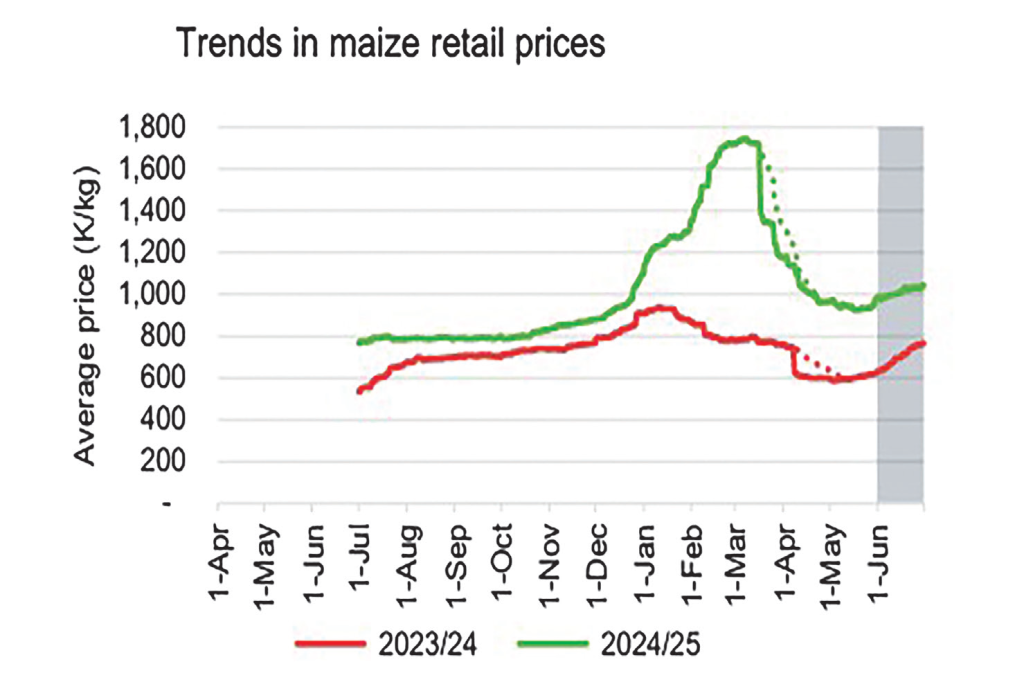
The experts were responding to an International Food Policy Research Institute (Ifpri) report for June 2025, which shows that maize prices jumped eight percent from K952 per kilogramme (kg) or K47 600 per 50kg bag to K1 031 per kg or K51 550 per 50kg bag.
This is moderate compared to same period last year when the staple grain rose by 23 percent from K612 per kg or K30 600 per 50kg bag to K753 per kg or K37 650 per 50kg bag.
Speaking in an interview on Tuesday, University of Malawi associate professor of economics Gowokani Chijere Chirwa observed that maize prices directly drive inflation, adding that when grain prices increase, prices of other commodities also rise.
He said: “In this country, inflation is largely driven by maize prices. When maize prices rise, people also tend to increase prices of other products to meet the cost of getting a grain. It’s like the fuel of the economy.
“But for producers, when the price is low, it means low returns compared to what they invested given the high costs of farm inputs. On the macroeconomy side, it means easing down of inflation. It may also just be an issue of cycle in inflation.”
The Nation spot-checks in some markets nationwide last week, however, showed that some vendors in Nsanje, Chikwawa Blantyre, Balaka, Mulanje, Mangochi and Lilongwe districts, are selling the grain at between K1 200 and K1 300 per kg, which is between K59 000 to K65 000 per 50 kg bag.
The Ifpri report indicates that maize prices increased across all regions in June, though the rate of increase varied throughout the country with Central Region registering the highest price followed by Northern and Southern regions.
Reads the report in part: “By the last week of June, maize averaged K913 per kg in the Northern Region, K1 036 per kg in the Central Region and K1 067 per kg in the Southern Region.
“Maize prices exceeded the government-mandated minimum farm-gate price of K1 050 per kg in only half of the monitored markets by the end of the month.”
The 2025/26 National Budget, which rolled out on April 1, was formulated based on the assumptions that inflation rate will average 23 percent and the economy will grow at 3.4 percent.
But the Reserve Bank of Malawi (RBM) has already revised the annual inflation rate projection to 27 percent and growth rate downgraded to 3.2 percent as inflation currently sits at 27.1 percent as of June this year, according to the National Statistical Office.
In a separate interview on Tuesday, Centre for Social Concern economic governance programme officer Agnes Nyirongo said the early rise in maize prices could complicate further the economic assumptions that anchored the national budget.
She said: “While prices have not yet reached emergency levels, the prevailing trends suggest that the lean season could bring serious affordability challenges if corrective measures are not implemented now.
“Maize price volatility is not just an economic issue. It is a social and humanitarian concern. Proactive, evidence-based action toda could prevent widespread hardship tomorrow.”
Nyirongo urged fiscal policy officials to ensure provision of real-time data on production, stock levels and prices for timely policy action.
“Government ministries and agencies must strengthen early warning systems to detect and respond to supply shocks. Reliable and transparent market data also helps dispel rumours and prevent panic buying, which can further destabilise prices,” she said.
Meanwhile, Consumers Association of Malawi executive director John Kapito has said the current maize price increases are creating unnecessary panic among consumers, considering that “we are not yet in lean period”.
“This is a serious warning to consumers to make sure that they should take care of any maize stocks they are holding, but also ensure that maize consumption must be controlled and avoid any abuses while at the same time begin to diversify diets,” he said.
RBM Deputy Governor Kisu Simwaka is quoted as having said on Facebook page that inflation continues to decline, benefiting from lower food prices on the back of improved food availability following the harvest.
He said: “On the policy front, the continued decline in inflation is opening the door for possible interest rate reduction in the coming months.
“Looking ahead, inflation is expected to decline further, supported by increased availability of food although the rate at which food prices will decline is uncertain because of the difficult regional food situation.”
But Simwaka said in general, the path to single digit inflation will likely be long and with some bumps.
Between April and June, Admarc Limited purchased 3 100 metric tonnes (MT) of maize against a targeted quantity of 20 000MT.
In total, the State produce trader is targeting to purchase 70 000MT in the 2025 harvesting season. However, about 20 000MT was planned for the first phase using the K20 billion allocation in the 2025/26 National Budget while the 50 000MT balance will be bought using K95 billion that Admarc is expected to borrow from commercial banks.
The 2024/25 harvest was estimated at 2.96 million MT, against the national requirement at 3.5 million MT, leaving a deficit of 537 380 MT.
Maize as part of the food component, accounts for about 53.7 percent in the consumer price index, an aggregate basket for computing inflation. This means that any movement in the price of maize either way has a bearing on the cost of food.